
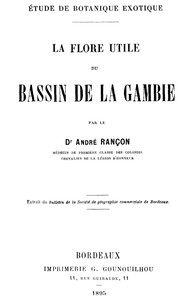
La flore utile du bassin de la Gambie by A. Rançon
Okay, let's be clear from the start: you won't find a thrilling narrative or complex characters here. La flore utile du bassin de la Gambie is exactly what the title says—a detailed catalog of the useful plants of the Gambia River basin, published in 1895. Think of it as a massive, organized field notebook. André Rançon, a French colonial administrator and botanist, systematically lists hundreds of plants. For each entry, he provides its scientific name, its local names (in languages like Wolof and Mandinka), a physical description, and, most importantly, a thorough account of its uses.
The Story
The 'story' is the journey of the catalog itself. Rançon didn't just copy from other books. He compiled this work through observation and, crucially, by talking to people. He recorded how plants were used for food, medicine, construction, tool-making, dye, and even ritual. One page might explain how a certain root is prepared to treat dysentery; the next describes the wood best suited for carving canoe paddles. The book moves region by region, plant family by plant family, building a comprehensive picture of how human life in 19th-century Gambia was intimately woven into the local flora.
Why You Should Read It
Reading this book is a unique experience. It's easy to see it as just a dry reference text, but if you slow down, it becomes something else. It’s a snapshot of a dialogue—however imperfect—between a European scientist and West African environmental knowledge. You feel Rançon's drive to document and classify, but you also get glimpses of the deep, practical intelligence of the communities he lived among. The real magic isn't in dramatic prose; it's in the accumulation of details. You start to see the forest not just as trees, but as a pharmacy, a hardware store, and a supermarket. It makes you look at your own surroundings differently. What useful knowledge about the plants in your own backyard have you never learned?
Final Verdict
This book is a niche treasure. It's perfect for history buffs, especially those interested in the history of science, colonialism, or West Africa. Gardeners and plant enthusiasts with a historical bent will find it fascinating. It's also a great resource for writers or world-builders looking for authentic, non-European-inspired details about how people actually use their environment. If you love primary sources that let you draw your own conclusions, this is for you. Just don't expect a novel—expect a time capsule, written in careful, technical French, waiting for a curious mind to unpack it.
This work has been identified as being free of known copyright restrictions. It serves as a testament to our shared literary heritage.
Kimberly Smith
6 months agoThis was exactly the kind of deep dive I was searching for, the step-by-step breakdown of the methodology is extremely helpful for students. This adds significant depth to my understanding of the field.
Jessica Lopez
2 months agoExtremely helpful for my current research project.
Charles Allen
1 month agoI have to admit, the author's voice is distinct and makes complex topics easy to digest. Truly inspiring.
Andrew Martinez
1 year agoPerfect.



Mary Perez
1 month agoThis digital copy caught my eye due to its reputation, the bibliography and references suggest a high level of research and authority. A rare gem in a sea of mediocre content.