
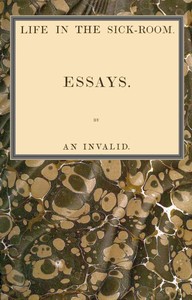
Life in the sick-room : Essays by Harriet Martineau
First published in 1844, Life in the Sick-Room is Harriet Martineau's deeply personal account of her experience as an invalid. For five years, a severe uterine tumor confined her to a single room, cutting her off from the active social and intellectual life she had known as a famous writer and thinker. This book is her attempt to explain that hidden world to the healthy people outside it.
The Story
There's no traditional plot. Instead, Martineau structures her thoughts into twelve essays that explore different facets of the invalid's life. She describes the physical space of the sick-room itself—how it becomes a universe. She writes with startling frankness about the patient's relationship with doctors, nurses, and visiting friends, noting the subtle (and not-so-subtle) power struggles and misunderstandings. She examines the mental landscape: the struggle against self-pity, the search for purpose in stillness, and the unique perspective on time, God, and human nature that develops when you are forced to watch life from the sidelines.
Why You Should Read It
I picked this up expecting a historical curiosity, but found a voice that felt incredibly modern. Martineau doesn't ask for sympathy; she demands understanding. Her insights are razor-sharp. She talks about the 'tyranny of the cheerful visitor' and the odd dignity in managing one's own suffering. What amazed me was her lack of sentimentality. She finds dark humor in her situation and uses her brilliant mind to dissect it, turning her confinement into a laboratory for observing humanity. It completely changed how I think about chronic illness and disability. This isn't a sad story; it's a fiercely intelligent one about adapting, observing, and asserting your selfhood even when your world has shrunk to four walls.
Final Verdict
This is a perfect read for anyone interested in the history of medicine, disability studies, or just superb personal essays. It's for readers who enjoy thoughtful, conversational nonfiction that tackles big questions from a unique angle. If you've ever felt isolated or confined in any way—physically or emotionally—Martineau's reflections will resonate deeply. It's also a fantastic introduction to a brilliant Victorian writer who deserves to be much more widely read. A quiet, profound, and surprisingly empowering book.
This work has been identified as being free of known copyright restrictions. Share knowledge freely with the world.
Nancy Clark
1 year agoUsed this for my thesis, incredibly useful.
Matthew Jackson
1 year agoBased on the summary, I decided to read it and the depth of research presented here is truly commendable. I learned so much from this.
Linda Johnson
1 year agoAmazing book.
Carol Lewis
1 year agoAfter hearing about this author multiple times, it challenges the reader's perspective in an intellectual way. Truly inspiring.





Margaret Johnson
4 weeks agoIf you're tired of surface-level information, the critical analysis of current industry standards is very timely. A solid investment for anyone's personal development.