
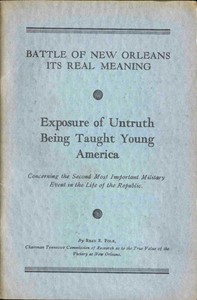
Battle of New Orleans: Its Real Meaning by Reau E. Folk
Most of us know the Battle of New Orleans as that weird historical quirk: Andrew Jackson and his ragtag crew whipped the British elite two weeks after the War of 1812 had officially ended. It's a fun story of underdog victory. Reau E. Folk's book asks us to forget that simple version. He pulls back the curtain on the political and military maneuvering that led to that moment.
The Story
Folk doesn't just recount the battle. He builds a case. He starts by looking at the man in charge of the American forces before Jackson: General James Wilkinson. Folk presents evidence that Wilkinson, a controversial figure often accused of being a Spanish agent, left the Gulf Coast defenses in a shambles on purpose. Then, he tracks how Jackson, taking over a near-impossible situation, managed to pull off a win against a seasoned British army. The heart of the book isn't the fighting itself, but the aftermath. Folk argues that the glorious myth of the battle was carefully crafted to bury Wilkinson's failures and boost Jackson's political career, effectively whitewashing a period of gross negligence and potential treason.
Why You Should Read It
This book is thrilling because it turns history into a puzzle. Folk connects dots between letters, official reports, and political reactions. You watch a national narrative being built in real time, and it feels less like destiny and more like savvy PR. It makes you look at all those 'glorious victory' stories in history books with a more skeptical eye. Jackson is still a hero here, but a more complicated one, stepping into a mess not of his making.
Final Verdict
Perfect for anyone who loves a good historical mystery or is tired of the same old patriotic tales. You don't need to be a War of 1812 expert to get hooked. If you enjoy books that challenge the standard version of events and explore the 'why' behind the 'what,' this is a fascinating, page-turning pick. It's for the reader who asks, 'Okay, but what are they not telling us?'
The copyright for this book has expired, making it public property. Knowledge should be free and accessible.
Nancy Garcia
4 months agoIt’s rare to find such a well-structured narrative nowadays, the attention to detail regarding the core terminology is flawless. Well worth the time invested in reading it.