
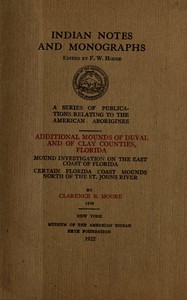
Additional mounds of Duval and of Clay counties, Florida; Mound investigation…
Okay, let's be clear from the start: this isn't a novel. Published in 1902, Additional Mounds of Duval and of Clay Counties, Florida is the detailed field report of Clarence Bloomfield Moore, a wealthy Philadelphia who spent his winters sailing his private steamboat, the Gopher, along Southern rivers to excavate Native American sites.
The Story
The 'story' here is the investigation itself. Moore systematically describes digging into numerous burial mounds near Jacksonville and along the St. Johns River. He documents what he finds at each spot: human remains, stunning shell and stone artifacts, and incredible ornaments made of copper and gold. The book is packed with precise measurements of the mounds, detailed drawings of pottery designs, and lists of every item recovered. There's no traditional plot, but there is a clear narrative of discovery—each chapter is a new site, a new dig, and a new batch of clues about the people who built these structures.
Why You Should Read It
You read this for the raw, unfiltered glimpse into another time—both the ancient past and the early days of American archaeology. Moore writes with a dry, factual style, but his passion is obvious. You get a real sense of the landscape of Florida over a century ago. More importantly, you witness the birth of questions we're still trying to answer: Which Native American cultures were here? What do these burial goods tell us about their society and trade networks? Just be prepared for a complicated feeling. Moore's work preserved a huge amount of information that would have otherwise been lost to farming or development, but his methods involved excavating graves without the consent of descendant communities. Reading it today is an exercise in seeing both the value of the data and the ethical shadows of how it was gathered.
Final Verdict
This is a niche read, but a fascinating one. It's perfect for local history buffs in Northeast Florida, anyone interested in the real, gritty beginnings of archaeology (before Indiana Jones glamorized it), or people who love primary source material. It's not a light read, but it's a direct line to a moment of exploration. Think of it less as a book and more as a time capsule of a curious man's adventures in the Florida soil.
This content is free to share and distribute. It is now common property for all to enjoy.
Jennifer Rodriguez
1 month agoThe layout of the digital version made it easy to start immediately, the author manages to bridge the gap between theory and practice effectively. Well worth the time invested in reading it.
Susan Thomas
2 years agoThe methodology used in this work is academically sound.
Emily Jones
10 months agoThis digital copy caught my eye due to its reputation, the insights into future trends are particularly thought-provoking. I am looking forward to the author's next publication.
Donald Williams
1 year agoIf you're tired of surface-level information, the evidence-based approach makes it a very credible source of information. Simple, effective, and authoritative – what else could you ask for?



Susan Lopez
1 year agoIt took me a while to process the complex ideas here, but the way it handles controversial points with balance is quite professional. Highly recommended for those seeking credible information.