1

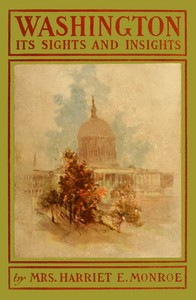
Washington, its sights and insights [1903] — A Reader’s Guide
4
1
Project Gutenberg
2023
Washington (D.C.) -- Description and travel
Readers of public-domain and historical texts
Project Gutenberg digital edition
en
Edition facts
Words: 47,309
Reading time: 206 min
Text sections: 32
Source:
Project Gutenberg record #70503
Monroe's 1903 guidebook uses a tour-like structure to present Washington, D.C., through detailed descriptions of government buildings, art, and anecdotes. The excerpts reveal a focus on insider stories, such as a counterfeiter's escapes, and a patriotic tone, offering a snapshot of the city's official life at the turn of the century.
Editorial Edition Score
4.9/5
★★★★★
★★★★★
Calculated from edition completeness, EPUB availability, text structure and catalogue metadata. Not a user rating.
Edition quality
Monroe opens with a chapter on the city's layout, but the excerpts quickly shift to a narrative style that blends architectural description with human-interest stories. The table of contents lists 29 chapters covering the Capitol, departments, and the Executive Mansion, but the sample text from later chapters reveals a penchant for dramatic anecdotes, such as the multi-page account of counterfeiter John Ogle's repeated jailbreaks. This suggests that the book is not a dry catalog but a lively, opinionated tour.
A Guidebook with a Storyteller's Voice
The opening chapters, as listed in the contents, follow a logical progression from the Capitol to the departments. However, the excerpt from the Secret Service chapter (XVI) shows Monroe abandoning straightforward description for a detailed criminal biography. She recounts Ogle's escapes with precise dates and locations—Jeffersonville, Cairo, Pittsburg—and includes dialogue, such as Ogle telling officers he knew of a "big 'plant' of spurious bills." This narrative density is unusual for a guidebook and suggests Monroe aimed to entertain as much as inform. Readers should expect digressions that prioritize color over conciseness.
The Counterfeiter's Tale as a Window into Bureaucracy
The Ogle story, spanning several pages, serves as an extended case study of the Secret Service's work. Monroe tracks his career from 1864 to the 1870s, noting each arrest, escape, and recapture. Details like "he broke from the jail where he was temporarily confined" and "donned the painter's clothes" emphasize ingenuity over moral judgment. This approach implies that Monroe viewed government departments as sources of drama, not just functions. The excerpt ends mid-sentence, leaving Ogle's fate unknown, but the level of detail indicates that such stories are central to her method.
Patriotic Art and Moral Lessons
Chapter XII, "Teaching Patriotism in the Capitol," hints at Monroe's didactic streak. The illustrations list includes "The First Reading of the Emancipation Proclamation" and "Washington Declining Overtures from Cornwallis," suggesting she uses art to instill civic values. In the excerpts, however, no direct commentary on these works appears. Instead, the Ogle story implicitly contrasts lawlessness with the orderly departments. Readers should watch for how Monroe connects physical spaces—like the Rotunda's Brumidi frieze—to moral or historical lessons, a technique that may feel dated but reveals early 20th-century attitudes.
What the Excerpts Leave Unsaid
The provided text covers only the Secret Service chapter and the front matter. Missing are the chapters on the Library of Congress, the Pension Office, and the Executive Mansion. Monroe's treatment of these is unknown, but the contents list 29 chapters, many on specific departments. The Ogle story, while vivid, may not be representative of the whole. The book's subtitle, "its sights and insights," promises both observation and interpretation, but without the full text, it's unclear how much weight Monroe gives to each. Readers should approach the book as a period piece, rich in detail but shaped by its author's biases.
Monroe's guidebook rewards readers who enjoy period-specific detail and narrative detours. The excerpts suggest that the book's value lies less in practical travel advice—much has changed since 1903—and more in its snapshot of how an early 20th-century author framed the federal government. Pay attention to the anecdotes: they often reveal more about the author's perspective than the buildings themselves.
Reader reflection
What did you think of this book?
Answer a few questions and save a private reflection on this device.
Your progress
0
/
10
2
Did this book hold your interest?
3
Would you recommend this book to another reader?
4
What was the reading difficulty like?
5
How distinctive were its ideas or approach?
6
Which element worked best for you?
7
What did you think about the pace?
8
Would you start a conversation about this book?
9
What changed or sharpened your thinking?
10