1

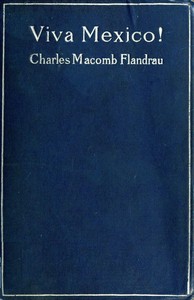
Viva Mexico! — Key Ideas to Explore
3
0
Project Gutenberg
2023
Mexico -- Description and travel; Mexico -- Social life and customs; Flandrau, Charles Macomb, 1871-1938 -- Travel
Readers of public-domain and historical texts
Project Gutenberg digital edition
en
Edition facts
Words: 67,478
Reading time: 294 min
Text sections: 6
Source:
Project Gutenberg record #72552
Charles Macomb Flandrau's observations of Mexican life, from the voyage to Vera Cruz to provincial posadas, mixing travelogue with social commentary and a wry, personal tone.
Editorial Edition Score
4.7/5
★★★★★
★★★★★
Calculated from edition completeness, EPUB availability, text structure and catalogue metadata. Not a user rating.
Edition quality
Charles Macomb Flandrau opens Viva Mexico! not with a landscape but with a critique of tourists and persons of fashion, whom he dismisses as unlikely to appreciate the slow, contemplative voyage from New York to Vera Cruz. The book’s structure follows his own movement through Mexico, alternating between descriptive passages and anecdotal scenes. Flandrau’s voice is conversational and self-aware, often undercutting his own observations with humor. The excerpts show a writer attentive to social rituals—the posada procession, the casino’s formal dances—and to the gap between foreign expectation and local reality. He is less a systematic ethnographer than a curious, sometimes sardonic participant.
The Voyage as Threshold
Flandrau devotes the opening chapter to the sea journey, framing it as a necessary prelude that separates the traveler from the hurried habits of home. He notes that the Ward line steamer offers “whole days when there is nothing to do but contemplate a cloudless sky and a semitropical sea.” This enforced idleness, he implies, is a condition for seeing Mexico properly. The voyage also introduces a recurring motif: the contrast between American expectations and Mexican realities. On board, the absence of “nice people” (meaning fashionable society) is presented as an advantage, clearing the way for more genuine encounters. The ship becomes a liminal space where the traveler sheds old categories before arriving at Vera Cruz.
Plaza, Café, and Casino
In the town of Barranca, Flandrau observes that the real clubs are not the formal casinos but the plaza and the central café. There, men read papers, smoke, have boots polished, and talk with friends. The casino, by contrast, is reserved for occasions—especially the nine posadas before Christmas. Flandrau describes the posada ritual in detail: a procession with candles, sung dialogue between the Holy Family and a closed door, and the eventual breaking of a piñata. He notes that no one takes the ceremony seriously, yet it is performed with exactness. This tension between formality and casualness recurs throughout the excerpts, as when a governor’s daughter, beautifully dressed, spends a “somber evening” because local youths are afraid to approach her.
Social Hierarchies in Motion
Flandrau’s account of the posada dance reveals a subtle social code. When he asks to meet the governor’s daughter, a friend hesitates. Flandrau’s attempt at a witty Spanish remark falls flat, but he dances with her several times. He notes that she was “agreeable and beautifully dressed” yet isolated, and that her brother was the only man in evening dress. The brother later changes into a frock coat, a detail Flandrau leaves unresolved: was the change for his own comfort or to put others at ease? Such moments show Flandrau’s eye for the unspoken rules that govern Mexican provincial society. He does not claim to understand them fully, but he records them with precision, letting the reader infer the weight of class and family reputation.
Tone and Self-Deprecation
Flandrau’s narrative voice is a key structural element. He often presents himself as an outsider who missteps or misjudges. In one excerpt, he recalls waiting for a train in a US prohibition town and asking a waitress for a drink—an anecdote that seems to illustrate his own obliviousness. This self-deprecation balances his sharper observations about Mexican customs. He does not pose as an expert; instead, he offers impressions filtered through a personality that is both curious and fallible. The prose is conversational, with dashes and asides that mimic spoken digression. This style keeps the reader close to the narrator’s immediate experience, even as the book moves between scenes of travel, festivity, and quiet observation.
Flandrau’s Mexico is a place of layered rituals and unspoken codes, best approached with patience and a willingness to be surprised. Readers will find that the book’s structure—moving from ship to town to private homes—mirrors the gradual deepening of the traveler’s understanding. Pay attention to the recurring images of light and darkness, the formal and the informal, and the narrator’s own shifting role from observer to participant.
Reader reflection
How did this book work for you?
Your answers remain private and are stored only in this browser.
Your progress
0
/
10
2
What was your overall reaction to the book?
3
How likely are you to recommend this book?
4
Did the language feel accessible?
5
Is this a title worth rereading?
6
Would this book work well in a reading group?
7
How did the reading compare with what you expected?
8
What did you appreciate most?
9
Which lesson or insight stayed with you?
10