1

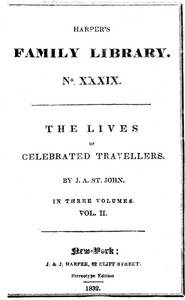
The Lives of Celebrated Travellers, Vol. 2 (of 3) — Edition Insights
4
1
Project Gutenberg
2021
Adventure and adventurers -- Biography; Travelers -- Biography; Explorers -- Biography
Readers of public-domain and historical texts
Project Gutenberg digital edition
en
Edition facts
Words: 114,300
Reading time: 497 min
Text sections: 18
Source:
Project Gutenberg record #65413
This volume profiles travelers from Tournefort to Cook, blending biography with natural history. St. John's narrative reveals how 19th-century editors shaped travel accounts, often emphasizing exotic details over scientific observation.
Editorial Edition Score
4.8/5
★★★★★
★★★★★
Calculated from edition completeness, EPUB availability, text structure and catalogue metadata. Not a user rating.
Edition quality
James Augustus St. John’s The Lives of Celebrated Travellers, Vol. II (1832) presents a series of biographical sketches that range from the botanist Tournefort to Captain Cook. The excerpts show a work that is as much about the traveller’s character as about the lands visited. St. John frequently interjects moral commentary, as when he notes that the New Zealanders would have “consigned the sailor to their subterranean ovens” had Cook not intervened. This editorial voice, typical of early 19th-century popular history, shapes the reader’s perception of each subject.
Biography as Moral Tale
St. John often frames his subjects’ experiences as lessons in virtue or folly. In the account of Cook’s voyage, he describes a native king, Poulaho, who “conducted himself with marked suavity and respect,” then adds that “few civilized individuals … could have shown more ease and self-possession.” The comparison elevates the “savage chief” while implicitly critiquing European manners. Similarly, the story of a sailor dragged from his “savage mistress” is presented as a near-escape from cannibalism, with the commander’s “humanely remitted” punishment underscoring the civilizing authority. These episodes reveal a didactic purpose: the traveller’s life is a mirror for the reader’s own moral improvement.
Natural History and the Traveller’s Eye
The volume’s catalog subjects—adventure, travel, exploration—are supplemented by a strong natural-history thread. Tournefort’s “early passion for botany” and Hasselquist’s studies under Linnæus indicate that scientific curiosity drove many of these journeys. Yet St. John’s treatment is uneven: he lingers on “dancing serpents” and “extraordinary ignis fatuus” while giving less space to systematic observation. The excerpt on the Friendly Islands mentions “curious religious ceremonies” but does not describe them in detail. This suggests that the book’s intended audience valued the marvellous over the methodical, a tension that modern readers may note between the subjects’ scientific aims and the popularizing lens through which they are presented.
The Editor’s Voice and the Limits of the Record
St. John does not simply compile; he interprets. When describing how distant islands were peopled, he declares that the discovery of Tahitians on Watteeoo “suffices to explain” the settlement of remote islands—a sweeping claim based on a single anecdote. Such leaps are common. The excerpts also show the editor’s reliance on secondhand sources: the account of Ledyard’s night with Poulaho is quoted directly, but the framing is St. John’s. Readers should be aware that the “lives” here are mediated by a compiler who shapes each narrative to fit a coherent, often moralizing, arc. The result is a portrait of the traveller as a figure of curiosity and courage, but also as a subject of a distinctly 19th-century editorial agenda.
Approach this volume as a document of its time rather than a transparent record of exploration. St. John’s choices—what to emphasize, what to omit, how to judge—reveal as much about the 1830s as about the travellers themselves. For a fuller picture, compare these sketches with the original travel narratives from which they are drawn.
Reader reflection
What was your reading experience?
Capture what you thought, learned, and would like to remember.
Your progress
0
/
10
2
How did the book work for you overall?
3
Is this a title you would suggest to others?
4
How much effort did this book require?
5
Did any part of the book feel personally relevant?
6
What did you appreciate most?
7
Could you apply anything you learned?
8
How strongly did the book affect you emotionally?
9
What did this book teach you most?
10