1

Tafilet — Edition Insights
3
0
Project Gutenberg
2023
Morocco -- Description and travel; Atlas Mountains
Readers of public-domain and historical texts
Project Gutenberg digital edition
en
Edition facts
Words: 88,757
Reading time: 386 min
Text sections: 11
Source:
Project Gutenberg record #70728
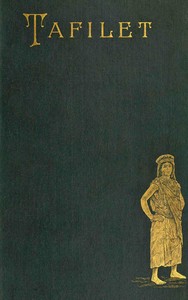
Walter B. Harris's 1895 narrative of exploration across the Atlas Mountains to the Tafilet oasis, based on his journey through Morocco. The book combines travelogue, ethnographic observation, and political reportage, with detailed descriptions of Berber villages, ksars, and the author's physical hardships.
Editorial Edition Score
4.9/5
★★★★★
★★★★★
Calculated from edition completeness, EPUB availability, text structure and catalogue metadata. Not a user rating.
Edition quality
Walter B. Harris begins his narrative not with a dramatic departure but with the mundane logistics of preparation: securing letters of introduction, hiring mules, and negotiating with local guides. The opening chapters establish a methodical tone, as Harris documents distances, supplies, and the political landscape of late-nineteenth-century Morocco. His prose is precise, often noting the exact dimensions of a fortress wall or the number of hours required to cross a pass. This attention to concrete detail—the height of a tower, the width of a gate—grounds the reader in the physical reality of the journey before the narrative moves into the more perilous terrain of the Atlas Mountains and the Sahara.
The Weight of Preparation
The early chapters of Tafilet are dominated by the practicalities of travel. Harris devotes considerable space to the process of assembling a caravan: the bargaining for camels, the hiring of Berber guides, and the procurement of food and water. He notes that his party carried "a few grains of green tea and a little sugar" as luxuries, while relying on dates and bread as staples. The narrative repeatedly returns to the theme of scarcity—of water, of shade, of reliable information. Harris's descriptions of markets in Marrakesh and Saffi are not merely picturesque; they serve as evidence of the region's trade networks and the difficulty of moving goods across the Atlas. The reader is made aware that every mile traveled required careful calculation of resources, and that the success of the expedition depended as much on diplomacy with local sheikhs as on physical endurance.
Architecture of the Ksar
Harris's descriptions of fortified villages, or ksars, are among the most vivid passages in the book. At Ul Turug, he notes that the settlement is "situated partly on the steep slopes of Jibel el Kebir and partly on the plain," with a wall punctuated by towers every 50 or 60 feet. The single gate, "under a heavy buttress in the centre of the east side," forces visitors to turn halfway upon entry—a defensive design that Harris explains with characteristic clarity. Inside, he observes a large square surrounded by buildings on two sides, with an arcade for sheltering animals and goods. These architectural details are not incidental; they reveal the social organization of the Berber communities he encounters, where defense, trade, and daily life are interwoven in the layout of the settlement. Harris's eye for construction and spatial arrangement gives the reader a tangible sense of place.
The Body Under Strain
As the journey progresses, Harris's narrative becomes increasingly concerned with physical suffering. Approaching Tafilet, he confesses that "the bitter cold at night, want of food and clothing at all times, the scorching rays of the sun by day, and the long marches made barefoot over the hot sand, had sorely taxed my strength." He describes the onset of a throat infection that makes swallowing painful, a recurrence of an illness he had suffered two years earlier. Yet he suppresses these complaints in the company of his men, "laughing and talking as gaily as I could." This tension between the author's private pain and his public composure is a recurring motif. Harris does not dwell on his suffering, but he records it with clinical precision, allowing the reader to infer the cumulative toll of the journey. The narrative thus becomes not only a record of exploration but a testament to the limits of human endurance.
The Sultan's Shadow
Throughout the later chapters, the presence of the Sultan of Morocco looms over the narrative. Harris's ultimate destination is the Sultan's camp at Tafilet, and his journey is shadowed by the risk of discovery by Arab tribesmen loyal to the court. At Ul Turug, he delays his entry until dusk "so as to run less risk of discovery," knowing that the ksar may contain men who would recognize him. The political context is never far from the surface: Harris must navigate the allegiances of Berber tribes, the authority of local sheikhs, and the delicate balance of power between the Sultan and the autonomous regions of the Atlas. His account of the accession of a new Sultan in the final chapter suggests that the journey was not merely a geographical exploration but a reconnaissance of a volatile political landscape. The reader is left to infer the strategic importance of the information Harris gathered.
Harris's narrative rewards readers who attend to its accumulation of small, concrete observations. The book is less a continuous adventure story than a mosaic of practical details—the height of a wall, the price of a camel, the taste of weak green tea shared in the shade of a tree. By tracing these details across the journey, the reader can reconstruct the physical and political geography of a region that Harris himself describes as largely unknown to European travelers. The value of Tafilet lies not in dramatic revelations but in the patient, unromantic record of what it took to cross the Atlas and return.
Reader reflection
How did this book work for you?
Your answers remain private and are stored only in this browser.
Your progress
0
/
10
2
What was your overall reaction to the book?
3
Would you recommend this book to another reader?
4
Did the language feel accessible?
5
Did the book give you something worth debating?
6
How would you rate its originality?
7
What was its emotional impact?
8
How clearly were the main ideas presented?
9
Which lesson or insight stayed with you?
10