1

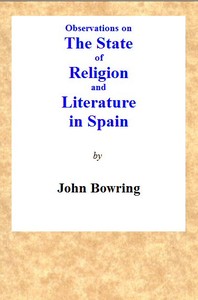
Observations on the State of Religion and Literature in Spain — Background and Themes
4
1
Project Gutenberg
2020
Spain -- Description and travel; Catholic Church -- Spain; Spain -- Religion; Spanish literature -- 19th century -- History and criticism
Readers of public-domain and historical texts
Project Gutenberg digital edition
en
Edition facts
Words: 12,817
Reading time: 56 min
Text sections: 2
Source:
Project Gutenberg record #61930
John Bowring's 1819 travel observations blend statistical estimates of Spain's clergy with satirical verse and critical commentary on Catholic ritual, literature, and the lingering effects of the Peninsular War.
Editorial Edition Score
4.4/5
★★★★★
★★★★★
Calculated from edition completeness, EPUB availability, text structure and catalogue metadata. Not a user rating.
Edition quality
John Bowring opens his 1819 travel record with a precise figure: two hundred thousand ecclesiastics in Spain, drawn from Antillon's calculations. This numerical anchor immediately establishes the work's method—mixing statistical observation with sharp cultural commentary. Bowring moves quickly from census data to a pointed distinction between the regular clergy, whom he calls 'intelligent and humane,' and the mendicant orders, described as 'unmanageable masses of ignorance and indolence.' The structure of the text alternates between such analytical passages and quoted verse, including a satirical poem that contrasts the friar's 'holy, uninterrupted laziness' with his 'cellar stor'd with rosy wine.' This oscillation between report and literary illustration gives the work its distinctive rhythm.
Clergy and the Twofold Division
Bowring's taxonomy of Spanish clergy rests on a functional and moral split. The regular clergy, he argues, 'dispens[e] benevolence and consolation in their respective parishes' and are 'friendly, in many instances, to liberty and devoted to literature.' The mendicant orders, by contrast, 'prey more directly on the labours of the poor.' This binary is not merely descriptive; it carries an implicit argument about reform. Bowring notes that the Peninsular War and the French invasion produced 'the destruction of convents, the alienation of church property, and the not unfrequent abandonment of the religious vow.' The upheaval, he suggests, has weakened the institutional power of the church, even as the government remains 'deeply interested in preserving their authority.' The text does not provide a full account of the war's effects, but the excerpts show Bowring using the disruption as a pivot for his critique.
Satirical Verse as Evidence
Bowring embeds a long satirical poem—attributed to a Spanish source—that lampoons the friar's life. The poem contrasts the friar's 'portly' figure and 'rosy wine' with the pretense of 'penury and pain,' culminating in the ironic couplet: 'O 'tis indeed a lovely sight / To see thus earth and heav'n unite.' The verse functions as a piece of ethnographic evidence, illustrating the popular perception of clerical hypocrisy. Bowring also quotes a proverb: 'Quien muchos romerias anda tarde ó nunca se santifica' (He who goes on many pilgrimages rarely becomes a saint). These literary citations are not decorative; they are woven into the argument as testimony from within Spanish culture. The poem's structure—alternating between pious language and material indulgence—mirrors Bowring's own rhetorical strategy of juxtaposing official doctrine with observed practice.
The Alliance of Church and the Arts
Bowring acknowledges that the Roman Catholic Church 'has made a glorious league with the fine arts,' and that 'poetry, painting and music can never pay the immense debt they owe to the gorgeous machinery of the Romish ritual.' This concession is notable because it complicates his otherwise critical stance. He provides specimens of devotional verse, including a litany of epithets for the Virgin: 'Fuente de amor y dulzura / Rio de bondad y de gracia.' The excerpts show Bowring moving between admiration for the aesthetic power of Catholic worship and condemnation of its institutional abuses. He does not resolve this tension, but the juxtaposition itself becomes a structural feature of the work. The reader is left to weigh the beauty of the 'Romanceros' against the 'shameful profligacy' that Bowring claims accompanies pilgrimages.
Movement Between Scenes and Sources
The text shifts rapidly between Madrid, the countryside, and literary references. Bowring cites Calderón on the dangers of pilgrimages, quotes a poem from 'Principe Perseguido,' and mentions the recalled Jesuits as 'a handful of ignorant, helpless old men.' These jumps create a mosaic effect: statistical tableaux, poetic interludes, and anecdotal asides follow one another without extended transitions. The excerpts do not reveal a continuous narrative journey; instead, Bowring organizes his observations thematically. The movement is not geographic but conceptual—from the economics of church wealth to the psychology of devotion to the politics of the restored monarchy. This structure demands that the reader hold multiple registers simultaneously: the satirical, the statistical, the literary, and the political.
Bowring's account is best read as a series of snapshots rather than a linear travelogue. The excerpts provide no sustained itinerary; instead, they cluster around the figure of the clergy and the cultural apparatus of Spanish Catholicism. Readers should attend to the way Bowring uses verse as evidence and to the unresolved tension between aesthetic appreciation and reformist critique. The work rewards attention to its shifts in register—from dry calculation to biting satire to quoted hymn—as these movements constitute its primary argumentative method.
Reader reflection
Take a moment to reflect on this book
Create a short personal record of your experience with this book.
Your progress
0
/
10
2
Did this book hold your interest?
3
How likely are you to recommend this book?
4
How much effort did this book require?
5
Did anything about the book feel genuinely new?
6
Would you start a conversation about this book?
7
Would a second reading be valuable?
8
What was its emotional impact?
9
What did this book teach you most?
10