1

Flint's Letters from America, 1818-1820 — A Reader’s Guide
3
1
Project Gutenberg
2024
United States -- Description and travel; Ohio River Valley -- Description and travel
Readers of public-domain and historical texts
Project Gutenberg digital edition
en
Edition facts
Words: 100,619
Reading time: 438 min
Text sections: 34
Source:
Project Gutenberg record #74346
James Flint's 1818–1820 letters offer a Scotchman's dispassionate observations on climate, agriculture, and settlement in the early Western states, with precise details on land quality, title insecurity, and the practical challenges facing emigrants.
Editorial Edition Score
4.9/5
★★★★★
★★★★★
Calculated from edition completeness, EPUB availability, text structure and catalogue metadata. Not a user rating.
Edition quality
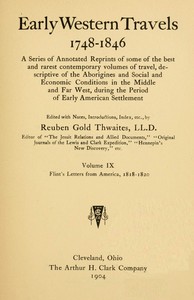
James Flint, a Scotchman of 'discriminating temperament' according to editor Reuben Gold Thwaites, wrote these letters during a two-year tour of the American West. Unlike many British travelers who provoked resentment with flippant criticism, Flint aimed for 'candor and good will,' depicting both the promise and the shadows of frontier life. His observations, originally published in 1822, are here reprinted as Volume IX of Thwaites's 'Early Western Travels' series, a collection of rare contemporary accounts of the trans-Allegheny region.
Flint's letters are notable for their concrete detail: he notes the price of military grant land at 'half a dollar per acre,' the prevalence of agues in low prairies, and the confusion of boundaries in Kentucky due to early surveys. He is particularly attentive to the interplay of land quality, health, and settlement patterns, offering a practical guide for prospective emigrants.
Land, Health, and Settlement
Flint repeatedly links the quality of land to its healthfulness. High lands are 'considered the most healthy,' while low, flat prairies, though rich in soil, are 'subject to agues.' This distinction shapes his assessment of each territory. In Indiana, he notes that non-resident purchasers have 'shut up a large proportion' of land from cultivation, but that judicious entries may still be made near White River. The new purchase from Indian tribes—'supposed to contain about six millions of acres'—is described as 'rich, diversified in surface' and better adapted to pasturage than the Ohio River bottomlands.
Flint's eye for practical detail extends to the tools and infrastructure of farming. The volume includes woodcuts of a horse rake, a buck saw, and a cradle scythe, suggesting that his letters were accompanied by illustrations of the implements he observed. His descriptions of the Ohio River as a 'great Western thoroughfare' and the potential for a canal between Lake Erie and the Illinois River reveal his interest in the region's economic connectivity.
The Problem of Land Titles
A recurring theme in Flint's letters is the insecurity of land titles, particularly in Kentucky and Virginia. He writes that 'much confusion as to boundaries prevails' because surveys were conducted 'when the country was in the possession of the hostile aborigines, and before the new method of laying out public lands was adopted.' The result is 'almost interminable' litigation, with 'many conflicting claims' on the same tract. This uncertainty, Flint argues, 'greatly prevents' the influx of new settlers.
In contrast, the public land system in Ohio and Indiana appears more orderly. Flint compares the land office maps for Jeffersonville and Cincinnati, noting that the former has 'many more vacancies,' indicating more unappropriated land. He also observes that the military grant in Illinois—'a hundred and sixty acres to each man' who fought in the late war—has been sold for as little as 'half a dollar per acre,' but that the district's low, flat terrain and prevalence of agues 'must greatly retard the improvement of the district.'
A Scotchman's Dispassionate Eye
Thwaites's preface emphasizes Flint's 'sound and just judgment, with capacity for philosophic insight.' Unlike many British travelers, Flint does not omit the shadows in his pictures, but presents them with 'dispassionate fairness' that removes the sting of criticism. This is evident in his treatment of Native American land cessions: he notes that a recent purchase will be 'soon abandoned by the natives,' and that 'upwards of a hundred families have entered it' to raise cattle and hogs, anticipating the sale of stock to future settlers. He reports these facts without moral commentary, focusing instead on the economic opportunities.
Flint's letters are also a record of the region's rapid transformation. He describes the 'vast quantities of land' in Illinois newly surveyed and brought to market, and the 'recent surveys' of Missouri totaling 'about a million of acres near Osage river.' His observations are grounded in specific numbers—acreages, prices, distances—that give the work a documentary precision rare in travel narratives of the period.
Readers approaching Flint's letters should attend to the interplay of his practical observations and his measured tone. He is neither booster nor critic, but a careful recorder of conditions as he found them. The volume's apparatus—Thwaites's editorial notes, the facsimile title page, and the woodcut illustrations—enhances its value as a primary source for understanding the early American West. Flint's work rewards those who read for concrete detail rather than narrative drama.
Reader reflection
What did you think of this book?
Answer a few questions and save a private reflection on this device.
Your progress
0
/
10
2
Did this book hold your interest?
3
Is this a title you would suggest to others?
4
How much effort did this book require?
5
What did you appreciate most?
6
Did the story or argument move comfortably?
7
Did the book give you something worth debating?
8
How distinctive were its ideas or approach?
9
Which lesson or insight stayed with you?
10