
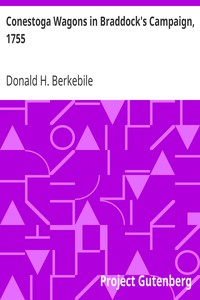
Conestoga Wagons in Braddock's Campaign, 1755 by Donald H. Berkebile
Most of us remember Braddock's Defeat as a military blunder—a British general walking into an ambush. Donald Berkebile's book shifts the spotlight from the generals and the muskets to the workhorses and the wagons. It tells the story of the 1755 campaign through its most critical, and most overlooked, component: its supply line.
The Story
The book follows General Edward Braddock's mission to capture Fort Duquesne (modern-day Pittsburgh). Berkebile details the monumental task of moving over 2,000 men and all their supplies—food, ammunition, tools, even cannons—through dense, roadless forests. The hero (and sometimes the villain) of this story is the Conestoga wagon. The book explains how these specific wagons were built, how many were needed, and where they came from. We see the army's progress measured not in miles, but in the backbreaking labor of clearing paths wide enough for these wagons to pass. Every delay, every decision to halt and build a bridge or grade a hill, is tied directly to the wagons. Berkebile argues that the wagons' slow, inevitable pace set the rhythm for the entire campaign, making the army a predictable target and contributing directly to the catastrophic finale.
Why You Should Read It
This book is a masterclass in seeing history from the ground up. Berkebile has a knack for making logistics fascinating. You feel the frustration of the wagoners struggling with broken axles in the mud, and you understand the immense pressure on Braddock, who was racing against time and his own supply train. It peels back the glamorous layer of warfare to show the gritty, practical reality. The wagons stop being just props; they become active characters whose limitations drive the plot of history. It changed how I look at any historical event—I now always wonder, "But how did they get their lunch there?"
Final Verdict
Perfect for history buffs who enjoy deep dives into the "how" behind the "what." If you're a fan of military history, colonial America, or even just great stories about problem-solving and engineering, you'll find this captivating. It's also a fantastic read for anyone who feels like the human stories behind big events often get lost. It's not a dry academic text; it's a clearly told, deeply researched story about an impossible job. Just be warned: after reading it, you'll never look at a horse-drawn wagon the same way again.
You are viewing a work that belongs to the global public domain. Feel free to use it for personal or commercial purposes.
Ashley Johnson
8 months agoThe analytical framework presented is both innovative and robust.
Emily Brown
7 months agoAs someone working in this industry, I found the insights very accurate.
Susan White
4 months agoThanks for the recommendation.
Ashley Williams
9 months agoAs someone who reads a lot, the flow of the text seems very fluid. I couldn't put it down.






Charles Lopez
1 week agoFrom a researcher's perspective, the nuanced approach to the central theme was better than I expected. An excellent example of how quality digital books should be formatted.